

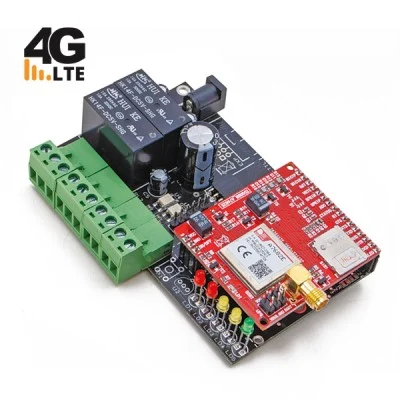
In an era defined by the rapid digitalization of infrastructure, the ability to monitor and control assets from virtually anywhere on the planet has moved from a luxury to an operational necessity. As legacy 2G and 3G networks are phased out across the globe, the transition to 4G LTE connectivity has become the new benchmark for reliable industrial communication. Standing at the forefront of this transition is the TDG140-4G, a sophisticated two-way remote control system designed to integrate seamlessly into modern automation landscapes.
Powered by the SIMCom A7682E module, this device represents a critical link for professionals in home automation, industrial telemetry, and remote security, offering a robust solution for environments where physical proximity to equipment is neither possible nor practical.
Main Facts: The Anatomy of the TDG140-4G
The TDG140-4G is more than a simple switch; it is a compact, intelligent node designed for robust, long-term deployment. At its core, the device utilizes the SIMCom A7682E, a high-performance LTE Cat 1 module that ensures longevity by leveraging 4G networks—a significant upgrade over older GSM-only systems that face obsolescence as telecommunications providers migrate to newer standards.
Technical Specifications and Capabilities
- Connectivity: LTE Cat 1 (4G) support for global network compatibility.
- Output Architecture: Dual relay outputs, offering both monostable (pulsed) and bistable (latched) operational modes. This allows the user to perform tasks ranging from opening a gate (momentary pulse) to switching on an HVAC system (latching).
- Input Monitoring: Two opto-isolated alarm inputs. These inputs are critical for monitoring external sensors—such as motion detectors, water level sensors, or power failure detectors—without risking damage to the controller’s internal circuitry.
- User Management: The system supports a directory of up to 8 stored phone numbers. These numbers serve as the primary contacts for system alarms, ensuring that critical data reaches the right personnel immediately upon an event trigger.
- Configuration Flexibility: Management is handled primarily through SMS commands, providing an offline, platform-independent way to configure the unit. For advanced users or initial commissioning, a local PC connection is available via the optional FT782M interface.
Chronology: The Shift from 2G to 4G LTE
The development of the TDG140-4G did not occur in a vacuum; it is the direct result of a decade-long technological migration in the telecommunications sector.
The Sunset of Legacy Networks
For years, the Internet of Things (IoT) relied heavily on 2G (GSM) and 3G (UMTS) networks. These standards were efficient for low-bandwidth telemetry. However, as mobile operators began to reclaim frequency bands to make room for 5G, the "2G Sunset" became a looming threat for thousands of remote systems worldwide.
The Birth of the A7682E Integration
Recognizing this shift, developers at Open Electronics sought to integrate the SIMCom A7682E into the existing framework of their TDG series. By maintaining the familiar form factor and command structure of its predecessors, the TDG140-4G ensures that technicians who are already trained in the TDG family can migrate to 4G infrastructure without a steep learning curve.

Current Market Standing
Today, the TDG140-4G occupies a vital niche. It bridges the gap between low-cost, unreliable consumer-grade smart plugs and high-end, complex Programmable Logic Controllers (PLCs). Its release signifies a stabilization period in remote control technology, where manufacturers are prioritizing connectivity longevity over experimental features.
Supporting Data: Why 4G LTE Matters for Telemetry
The transition to LTE is not merely about speed; it is about reliability and future-proofing. When assessing the effectiveness of a remote control unit, three factors remain paramount: signal penetration, network longevity, and command latency.
Signal Penetration and LTE Cat 1
Unlike higher-speed broadband categories (Cat 4 or above) which are designed for streaming, LTE Cat 1 (the standard used by the A7682E) is specifically optimized for M2M (Machine-to-Machine) communication. It consumes less power and provides a more stable connection in fringe areas where signal strength is variable. This is critical for remote installations, such as mountain-top weather stations or agricultural pumping stations, where standard cellular coverage might be weak.
Operational Redundancy
The use of SMS as a communication medium—even while utilizing a 4G module—is a strategic choice. In scenarios where data networks might experience high traffic or temporary outages, SMS often remains the most resilient protocol for command and control. By leveraging the A7682E’s capability to handle SMS alongside data, the TDG140-4G ensures that the user maintains control even when mobile data services are throttled or congested.
Official Responses and Industry Perspectives
Industry experts have praised the move toward standardizing on the SIMCom A7682E module. In a landscape increasingly crowded with proprietary, closed-source ecosystems, the open-architecture approach of the TDG140-4G is viewed as a significant benefit for system integrators.
- System Integrators’ Feedback: Technicians often highlight the "optically isolated" nature of the inputs as a major selling point. In industrial environments, ground loops and electrical noise can destroy sensitive electronics. By isolating these inputs, the device offers a layer of protection that is often overlooked in cheaper alternatives.
- Ease of Configuration: The decision to keep configuration via SMS has been met with positive reception from the field. It eliminates the need for expensive software licenses, complex cloud logins, or constant internet access. For a technician in the field, a simple mobile phone is all that is required to reconfigure a relay behavior or update an authorized contact number.
Implications: The Future of Remote Infrastructure Management
The introduction of the TDG140-4G carries profound implications for the way we handle remote maintenance and automation.

Lowering the Barrier to Entry
By making high-reliability remote control accessible through a user-friendly interface, the TDG140-4G lowers the barrier for small-to-medium businesses to modernize their infrastructure. A farmer can now monitor silo levels; a small business owner can secure their premises; and a facility manager can reset breakers—all without investing in a massive, proprietary building management system.
The Sustainability Factor
One of the most overlooked aspects of the TDG140-4G is its role in sustainability. By enabling remote resets, fewer physical visits to remote sites are required. This reduction in "truck rolls"—the industry term for sending a service vehicle to a site—significantly reduces the carbon footprint of maintenance teams. Every time a system can be reset via a 4G command instead of a 50-mile drive, the efficiency of the operation increases.
Security and Data Privacy
In a world of "cloud-first" solutions, the TDG140-4G offers a more private alternative. Because the device is managed locally or via SMS, data does not necessarily need to reside on a third-party server. For organizations that prioritize data sovereignty and air-gapped security, this direct, device-to-user communication model is an essential feature.
Conclusion: A Vital Tool for a Connected World
The TDG140-4G is a testament to the fact that effective engineering does not always require reinventing the wheel; sometimes, it requires perfecting the spokes. By combining the proven reliability of the SIMCom A7682E with a robust, two-relay, two-input architecture, the device provides a reliable lifeline for industrial and residential remote management.
As we continue to navigate the decommissioning of 2G and 3G networks, the necessity for devices that can comfortably operate on the 4G standard will only grow. Whether it is used for complex industrial automation or simple household security, the TDG140-4G stands as a versatile, durable, and highly capable solution for those who require absolute control, regardless of the distance between them and their equipment.
For those interested in exploring the technical documentation or acquiring the device, the Open-Electronics Store provides the necessary resources to integrate this technology into your own automation stack. As we move further into the decade, the TDG140-4G is positioned to be a cornerstone of the next generation of remote connectivity.